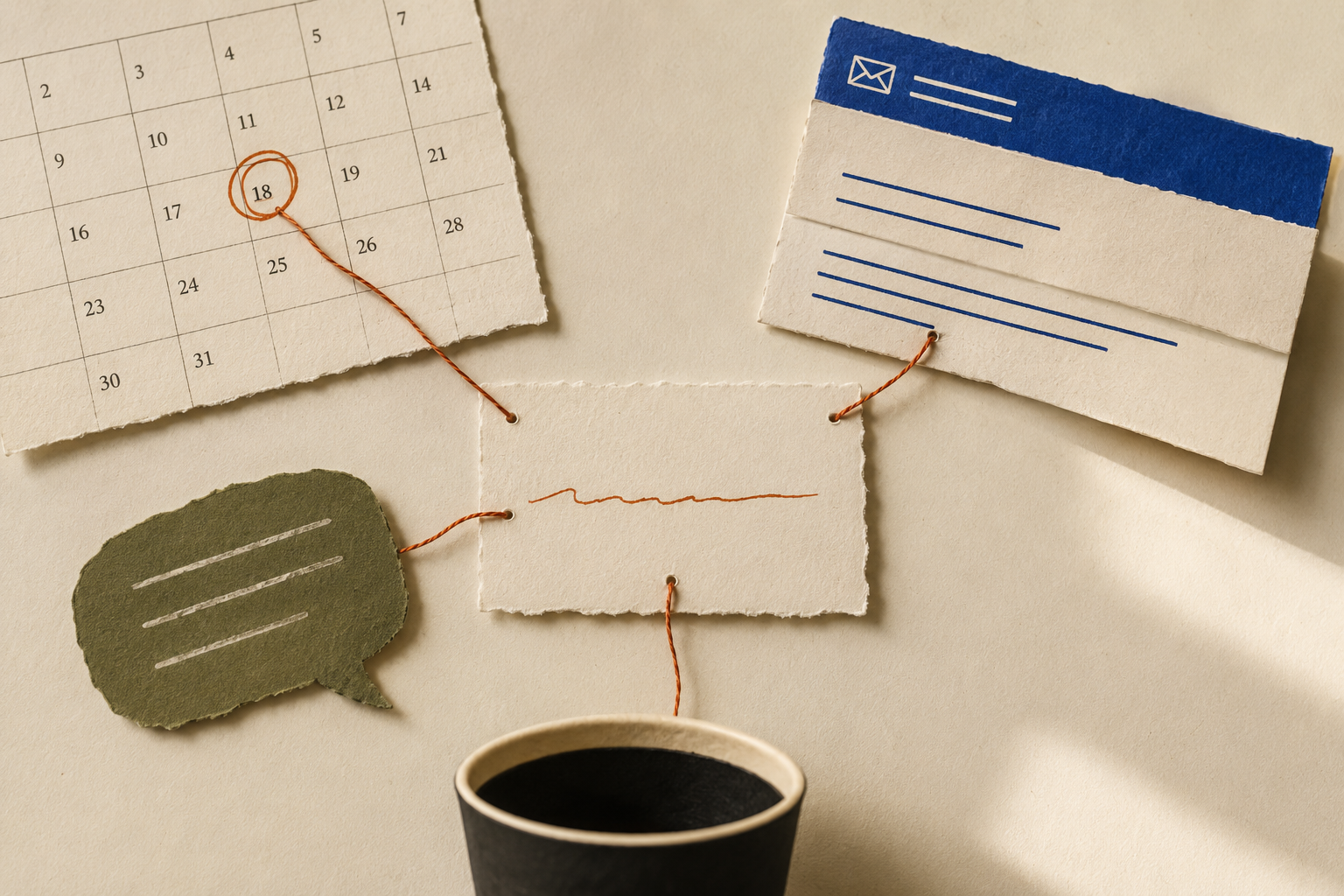
¶A CEO walks into a Thursday board meeting to talk about the pipeline. She's prepared and has read the deck twice. What she hasn't seen, because nobody sent it to her, is the three conversations from the last seventy-two hours that are about to decide how the meeting goes. A customer-success call on Tuesday where the largest account mentioned, almost in passing, that their own budget cycle moved. A Slack thread between two account executives Wednesday morning arguing about whether to pull forward the enterprise deal that makes the quarter. A forwarded email from Wednesday night that the CFO skimmed and filed. None of those three artifacts made it into the board deck, or anywhere else. They're sitting in three separate systems, surfaced to nobody, and they're the entire meeting.
¶Every executive has a version of this story. Most of them don't notice the story is happening, because someone on their staff is making sure it doesn't. That person is usually called a chief of staff, or sometimes an executive business partner, or sometimes just the operator who sits two desks down and happens to read everything. The job title matters less than the skill. The skill is reading the room.
¶Reading the room is a real thing, not a turn of phrase. It's what the best chiefs of staff do for a living. It's noticing what isn't in the document. It's hearing the pattern across three customer calls nobody else sat in on. It's knowing, on Wednesday, that the conversation from last Tuesday's offsite is about to come up in Thursday's board meeting, and pulling it forward before anyone has to ask. The phrase has survived as a business idiom because the skill it describes is rare, valuable, and almost entirely invisible when it's working.
¶It's also, on its face, what every AI product this year claims to be getting at. Proactive! Contextual! Personalized! Agentic! Crustaceous! The adjectives are doing a lot of work. Open the actual products and you find the same shape underneath almost all of them. A prompt box, a cursor, a model waiting for you to type. The best ones give you good answers. None of them notice.
¶That's the gap. Chat-based AI waits to be asked. Search assumes you already know the question. Even the products that market themselves as proactive usually mean they'll email you a digest at 7 a.m. or nudge you about a calendar conflict you already knew about. The most thoughtful consumer AI you have on your machine today is, structurally, a suggestion engine sitting behind a prompt. The prompt is the bottleneck. The whole design assumes you will arrive at your desk knowing what to ask, which is exactly the problem a good chief of staff solves for you.
The prompt is the bottleneck.
¶The reason almost nothing does this well is that it's hard in two different ways at once. Reading the room is an aggregation problem and a judgment problem. You need to see across every channel the company talks on, email, calendar, meetings, CRM, shared drives, messaging, ticketing, finance. You need to hold it all in a single working context. Then you need to know, out of the tens of thousands of artifacts flowing through a 200-person company in a given week, which three are about to matter on Thursday morning. The aggregation is an engineering problem. The judgment is a cognition problem. Issue No. 01 of this Brief argued that cognition, not memory, is where defensibility lives in enterprise AI. This is what that argument looks like applied to attention rather than search. Noticing is cognition too.
Noticing is cognition too.
¶A handful of teams have started to do pieces of it. Glean's Spring 2026 release shipped proactive agents that surface action items from the personal graph without being asked. Copilot now pre-briefs a Teams meeting before it starts, with context pulled from inside the Microsoft tenant. Google Workspace Intelligence and Anthropic's Orbit, both announced in the last month, watch across several channels at once, Gmail and Chat and Drive in Workspace's case, Gmail and Slack and GitHub and Drive in Orbit's. These are useful. They're also, each of them, a perimeter. Workspace Intelligence is Google watching Google. Orbit is Anthropic watching the apps Anthropic indexed. Each one is reading more than a single channel and still calling its perimeter the room. None of them carry a year of a company's decisions forward as memory.
¶Reading the room, in the sense a chief of staff means it, is cross-channel by definition. The signal is the thing that showed up in five places this week, none of which alone looked like a trend. The alert worth sending is the one that noticed the customer-success call, the support ticket, and the quiet account-team thread pointing at the same fact. The briefing worth reading thirty minutes before a meeting is the one that pulled in the three threads you didn't think to connect, because you weren't in all three rooms. No single-system product can do that. The shape of the problem requires a system that sits above the systems.
¶When software actually does this, the experience is not dramatic. That's part of why it's been so hard to build toward. A good chief of staff isn't flashy. They hand you a page and a half before a meeting and the meeting goes well. They send a two-line note on Tuesday and a deal doesn't slip on Friday. You don't notice the save, because the save is the absence of a problem you would otherwise have had. The product version looks the same. A brief that arrives thirty minutes before the call and makes the call shorter. An alert that flags a customer signal across three channels your reps would not have stitched together on their own. A pattern surfaced on Thursday because it showed up in five places between Monday and Wednesday, and the system noticed the shape before anyone named it.
¶This is the part of the category that's underbuilt. Every vendor in enterprise AI right now is building a better way to answer you when you ask. Far fewer are building a system whose entire job is to notice on your behalf. The ones that will matter are the ones that invert the default posture of the tools. Not a faster response to a prompt. A quieter tap on the shoulder before the prompt would have occurred to you.
¶The right anchor is the chief-of-staff role, taken literally. The AI worth paying for in a company is not a helpful intern who answers crisply when spoken to. It's the staff member whose entire job is to notice, to hold the thread, to know what's about to matter on Thursday because of what happened on Tuesday in a meeting you weren't in. That role exists in every well-run company, and it is almost always the single most leveraged hire on the org chart. Most companies cannot afford to make it, or cannot make it well enough, or cannot make it at the scale the work requires.
¶Maasv reads the room so the people who are actually in it can decide what to do.